1. Product Overview
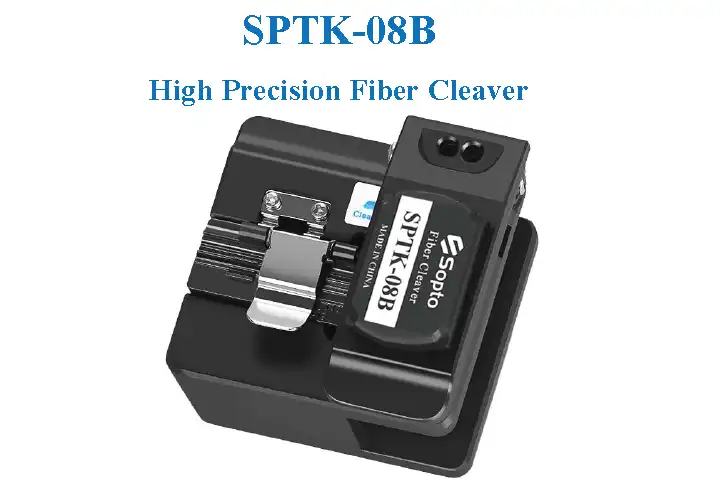
The SPTK-08B is a High Precision Fiber Cleaver developed by SOPTO for precise cleaving of fiber end faces. It features a tungsten steel blade and a three-in-one fixture design that accommodates bare fibre, pigtail, and tensile cable, while also supporting the cleaving of optical cables. The cleaving surface is flat with an accurate angle, effectively reducing splicing loss, making it a common tool for fibre installation and maintenance.
The cleaver is equipped with an automatic knife return function. Through a high-quality slide rail mechanism and a protective cover, the blade automatically returns to its original position when the cover is opened, reducing manual intervention and improving operating efficiency. The compact body measures 67×60×56mm, making it easy to carry to field sites.
67×60×56mm
Dimensions
Tungsten Steel
Blade Material
Three-in-one
Fixture Design
Automatic
Knife Return
2. Key Features
- Robust Rust Prevention: The body undergoes an effective rust prevention treatment to withstand various operating environments and extend service life.
- Automatic Knife Return: A high-quality slide rail mechanism combined with a protective cover design returns the blade to its starting position automatically when the cover is opened, simplifying operation.
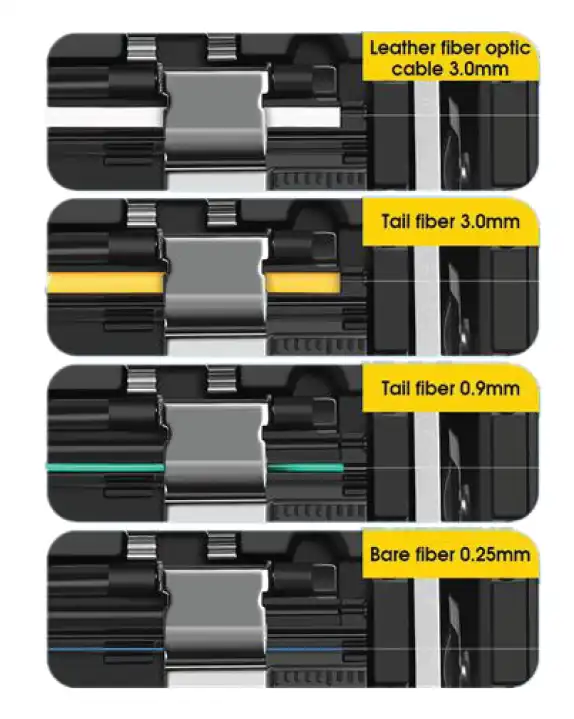
- Three-in-one Fixture: A single fixture accommodates bare fibre, pigtail, and tensile cable without the need for replacement. It also supports optical cable cleaving and includes a built-in scale ruler, eliminating the need for an additional measuring tool.
- Tungsten Steel Blade: The blade is made of tungsten steel, offering high hardness and excellent wear resistance to ensure consistency and durability of the cleaving surface.
- Hot and Cold Splicing Compatible: The cleaving surface is suitable for both fusion splicing (hot melt) and mechanical splicing (cold joint) processes.
- Precise Angle Cutting: The cleaved end face is flat with an accurate angle and a smooth surface, effectively reducing splicing loss.
3. Technical Specifications
| Parameter | Specification |
|---|---|
| Product Name | High Precision Fiber Cleaver |
| Blade Material | Tungsten Steel |
| Fixture Type | Three-in-one (Bare fibre / Pigtail / Tensile cable) |
| Knife Return | Automatic return (slide rail mechanism) |
| Rust Prevention | Effective rust prevention |
| Splicing Process | Fusion splicing (hot melt) / Mechanical splicing (cold joint) |
| Cleaving Quality | Precise angle cutting, flat and smooth cleaving surface, low loss |
| Scale Ruler | Built-in scale, no additional measuring tool required |
| Dimensions (L×W×H) | 67mm × 60mm × 56mm |
4. Applications
- Fibre Fusion Splicing: Precisely cleaves the fiber end face before fusion splicing to ensure splicing quality.
- Mechanical Splicing: Provides a qualified cleaved end face when using mechanical splices for fibre interconnection.
- Fiber to the Home (FTTH) Installation: Cleaves drop cables on site, with a compact body that is easy to carry.
- Optical Cable Construction and Maintenance: Supports the cleaving of tensile cables, making it suitable for optical cable construction sites.
5. Ordering Information
| Model | Product Description |
|---|---|
| SPTK-08B | High Precision Fiber Cleaver |
For customised services, please contact SOPTO through the following:
Email: info@s-opto.com
Website: www.s-opto.com
6. Glossary
| Term | Full Name | Definition |
|---|---|---|
| Fiber Cleaver | Fiber Cleaver | A tool used to precisely cleave fiber end faces; cleaving quality directly affects splicing loss. |
| Tungsten Steel | Tungsten Steel | A cemented carbide with tungsten as the main component, offering high hardness and wear resistance, suitable for cleaver blades. |
| Bare Fibre | Bare Fibre | The fibre exposed after the coating layer is stripped, typically prepared before fusion splicing. |
| Pigtail | Pigtail | A fibre with a connector on one end and a bare fibre on the other, used in fibre distribution frames and similar scenarios. |
| Fusion Splicing | Fusion Splicing | A splicing method that uses an electric arc to heat and melt two fiber end faces together, offering low loss. |
| Mechanical Splicing | Mechanical Splicing | A splicing method that aligns and secures two fiber end faces using a mechanical splice, without the need for a fusion splicer. |